

Modern aerospace research does not suffer from a lack of data. The real challenge is making data understandable and reusable across the many tools, organisations and lifecycle stages involved in the development of an aerostructure. CompSTLar addresses this challenge through a modular digital framework that connects design, material development, manufacturing, structural health monitoring, repair and recycling. Within this environment, Asset Administration Shells (AAS) can provide an important semantic layer for organising information around the assets and processes that make up the project.
For the CompSTLar team, the objective is not simply to create digital representations. The aim is to build AAS models and submodels that describe information in a structured, machine-readable and interoperable way, so that data generated in one stage of the lifecycle can remain meaningful when it is reused in another.
From connected data to shared meaning
The CompSTLar digital pipeline brings together very different kinds of information. Material specifications and batch metadata may be created during tape production; automated manufacturing can generate machine parameters, thermal maps and inspection results; embedded sensors can produce time-series data during structural health monitoring; repair activities add new process and quality information; and end-of-life operations generate data about recovered material and its suitability for reuse.
Connecting all of these sources is already a significant engineering task, but connectivity alone does not guarantee interoperability. Two systems may exchange a value called temperature, for example, while referring to different physical quantities, units, process steps or assets. A common semantic model adds the context required for software systems to interpret information consistently. This is where AAS becomes particularly relevant: it provides a standardised way to describe an asset and organise its information into submodels with clearly defined meaning, structure and relationships.
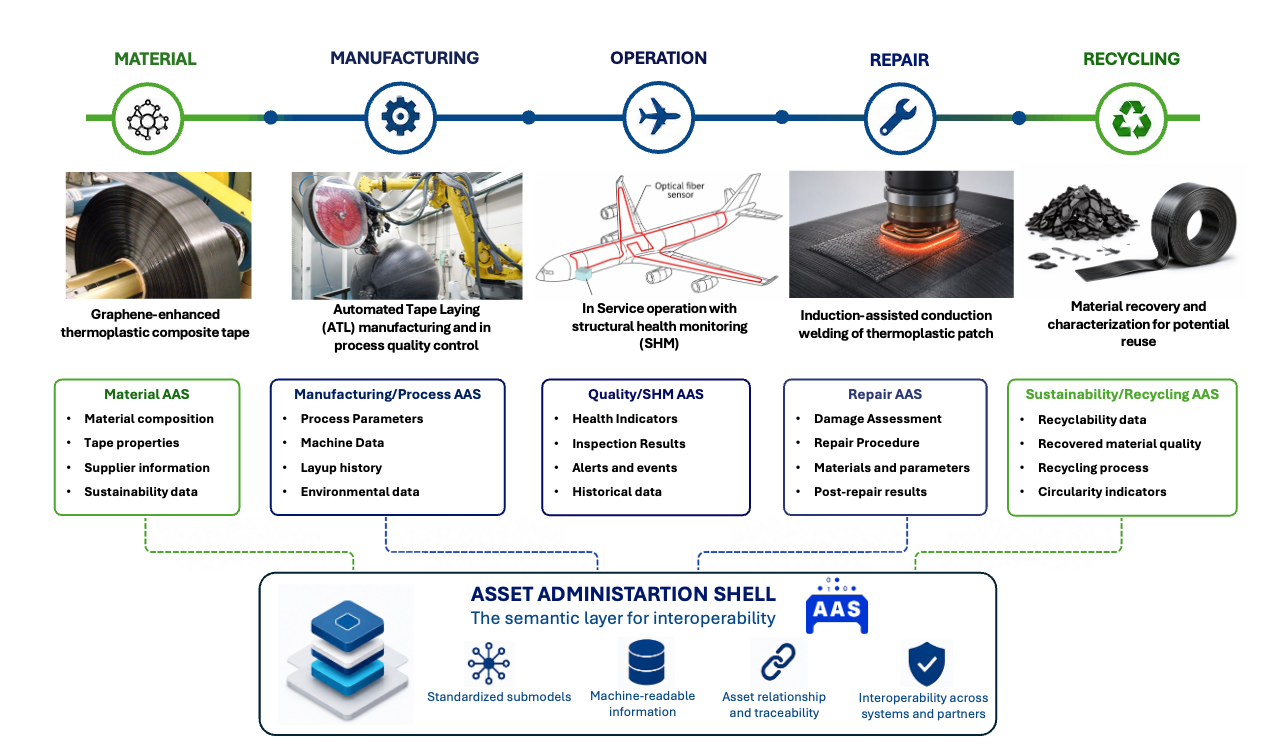
Figure 1: Asset Administration Shells as a semantic layer connecting lifecycle information across the CompSTLar aerostructure digital thread.
AAS as part of the CompSTLar digital thread
CompSTLar envisions a digital thread that follows composite aerostructures across their lifecycle, linking manufacturing history, inspection data, simulations, repair records and recycling information. AAS can complement this architecture by providing consistent digital representations of relevant assets and by connecting their data to the wider digital ecosystem.
Rather than treating every dataset as an isolated file or database entry, an AAS-based approach makes it possible to associate information with the asset to which it belongs. Different submodels can describe, for example, material characteristics, manufacturing and process information, quality results, structural health monitoring data, repair information or sustainability indicators. These structured representations can then support higher-level services such as digital twins, analytics, decision-support tools and lifecycle traceability.
This semantic consistency is particularly valuable in a multi-partner research environment. A manufacturing partner, an inspection specialist and a digital-twin developer may use different software and data formats, yet still need to refer to the same component, process step or quality result. By preserving common identifiers, definitions and relationships, AAS can reduce the need for repeated point-to-point mappings and make information easier to discover and reuse as it moves through the project. The objective is not to replace every database or engineering tool, but to give their information a shared digital context.
Looking ahead
As CompSTLar progresses from framework definition towards implementation and demonstration, the AAS work will focus on identifying which project assets and information flows benefit most from semantic modelling, defining appropriate submodels and connecting them with the digital pipeline. The value of this work will be measured not by the number of models created, but by how effectively they enable information to be discovered, understood, linked and reused across partners and lifecycle stages.
Combining advanced composite materials, smart manufacturing, structural health monitoring, repair, recycling and semantic data management creates an opportunity to build aerostructures whose digital history is as carefully engineered as their physical structure. AAS can help make that history interoperable, traceable and reusable – strengthening the digital foundation for more efficient, sustainable and collaborative aerospace manufacturing.
This article reflects the CompSTLar Digital Framework specifications and ongoing AAS submodel modelling activities, including participation in IDTA standardization work on Manufacturing Work Description (IDTA 02100).