
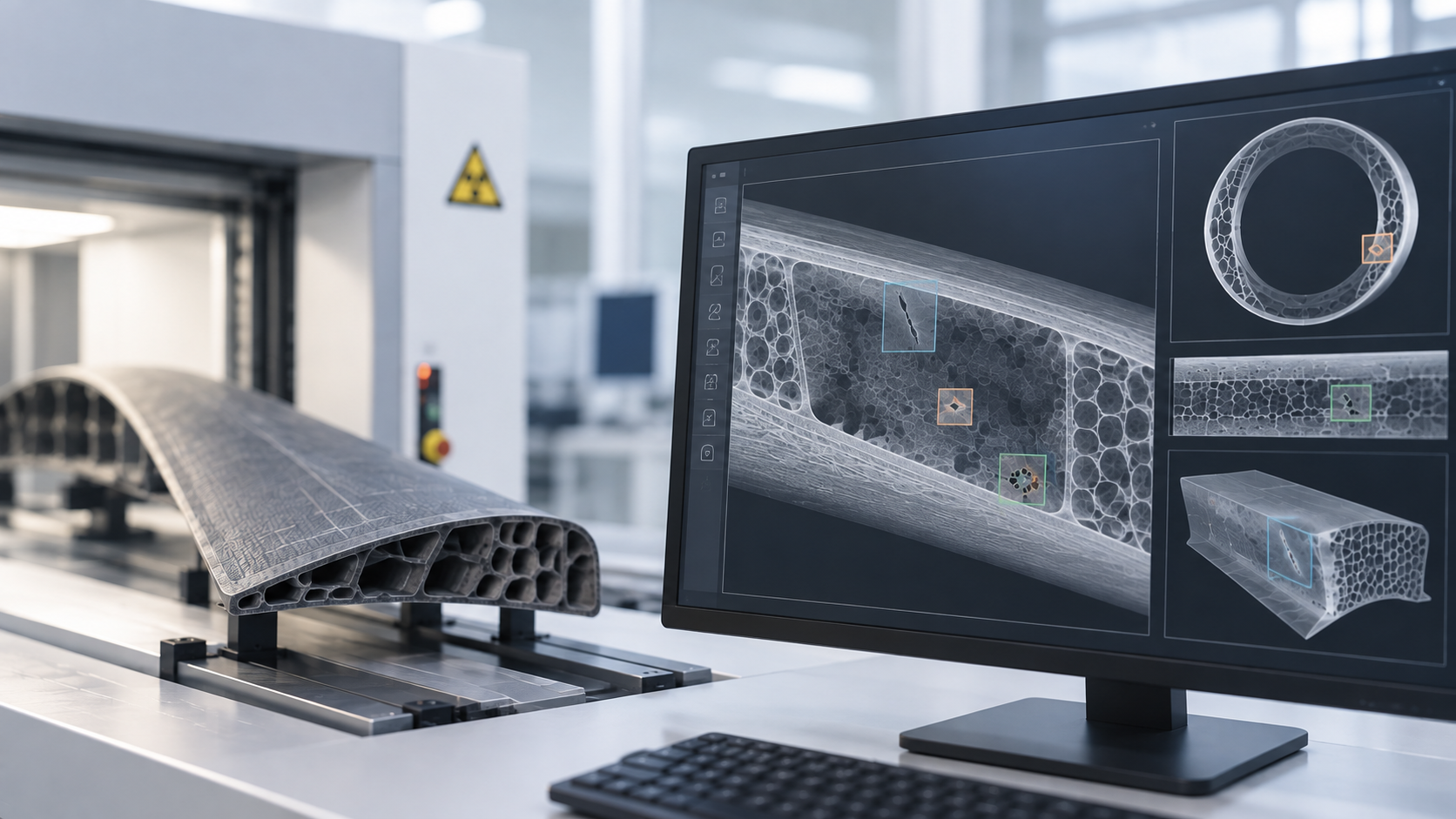
Industrial quality control increasingly relies on imaging techniques such as X-ray radiography and computed tomography to inspect the internal structure of components without damaging them.
These methods can reveal features that are difficult or impossible to observe from the surface, including pores, cracks, inclusions and manufacturing irregularities.
However, interpreting large volumes of inspection data can be demanding. Each image must be examined carefully, and the relevance of a detected feature depends on factors such as its size, position, shape and the intended application of the component.
This is where artificial intelligence and machine learning can assist.
Models trained on representative inspection data can help identify image regions that may contain anomalies, segment features of interest and support their quantitative characterization.
Rather than replacing conventional non-destructive testing or expert judgement, these tools can serve as an additional layer of analysis: helping specialists prioritize inspections, apply evaluation criteria more consistently and manage increasingly large imaging datasets.
Developing a reliable system involves much more than training a model. The quality and representativeness of the data are critical, as are careful validation and an understanding of the model’s limitations. Changes in materials, component geometry, imaging equipment or acquisition parameters can affect performance.
For safety-critical applications, predictions must therefore remain traceable, be evaluated under relevant operating conditions and be reviewed by qualified personnel.
The objective is not simply to automate image classification. It is to combine advanced imaging, materials knowledge and data-driven methods to create quality control workflows that are more efficient, reproducible and informative.
AI may not literally give us X-ray vision, but when used responsibly, it can help us extract more value from the images we already produce and support better-informed decisions in materials engineering and manufacturing.
Author: Jorge Cabrejas, predoctoral researcher at IMDEA Materials Institute