



Collaboration starts with the right environment: Meet Irati Sanchez Duo
To really thrive in STEM, it's not enough to work on exciting research; you also need to be part of a team that supports its members, values collaboration, and fosters a healthy working culture.
”
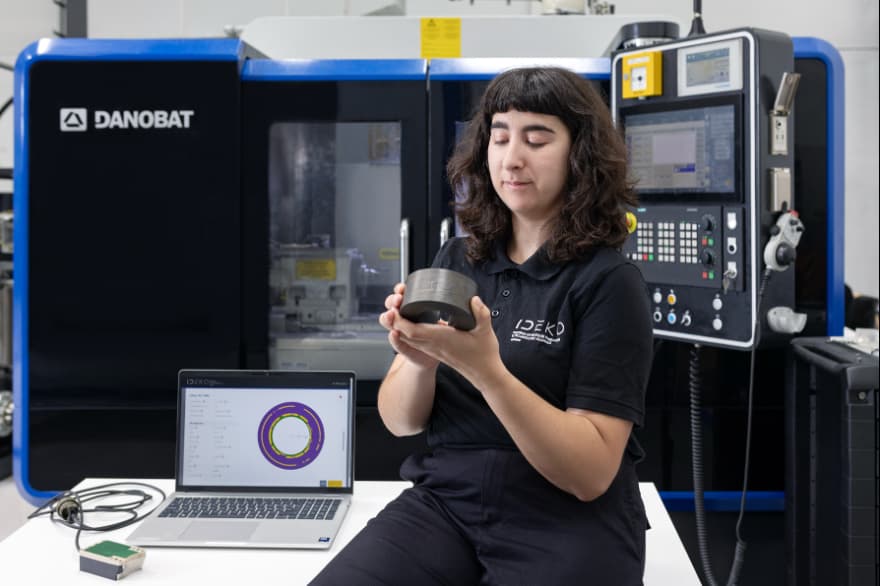
Innovation rarely happens in isolation. It grows through collaboration, the exchange of different perspectives and the willingness to take on new challenges. In our Women in STEM campaign, we are highlighting the women contributing to CompSTLar and exploring how their experiences shape the way they approach innovation, leadership and collaboration.
In this edition, we meet Irati Sanchez Duo, a Non-Destructive Testing (NDT) Researcher at IDEKO, where she works on the development of smart and integrated inspection solutions for advanced manufacturing processes. With a PhD in Manufacturing Engineering and an MSc in Advanced Materials, her work focuses on ultrasonic and eddy current technologies to ensure the quality and reliability of advanced manufactured components.
Within CompSTLar, Irati and her team at IDEKO are responsible for the non-destructive inspection of composite parts using advanced ultrasonic technologies. Their work focuses on developing and validating inspection methods capable of detecting internal defects, such as porosity, without damaging the components.
These inspection results are essential not only for guaranteeing the quality of manufactured parts, but also for providing reliable data to the project’s digital models, contributing to a more automated, efficient and trustworthy approach to composite manufacturing for high-performance aerospace applications.
“What I enjoy most about my work is that it combines research with real industrial challenges. It’s rewarding to develop technologies that can have a direct impact on how advanced aerospace components are manufactured and inspected in the future.”
A natural curiosity for engineering
For Irati, the path into STEM was not shaped by one defining person or moment. Instead, it developed naturally from an early enjoyment of learning and curiosity about how things work.
“I’ve always enjoyed going to school and learning new and interesting things every day.”
From a young age, she knew she wanted to study engineering. What attracted her was the breadth of the field and its combination of theory and practical problem-solving.
“I liked that engineering is such a broad field, where you can learn about many different topics while combining theory with practical, hands-on work.”
That same curiosity continues to shape her work today, where research, experimentation and industrial challenges come together to develop new inspection technologies.
From research to real-world impact
One of the most rewarding aspects of her career is having what she describes as a “front-row seat to innovation”, watching ideas evolve from research and experimentation into solutions that can eventually be applied in industry.
For her, this is also what keeps research exciting. Every project brings new challenges, technologies and problems to solve, meaning that there is always something new to learn.
Working within multidisciplinary and international teams has reinforced this perspective. She believes that bringing together people with different backgrounds and areas of expertise creates opportunities for ideas and solutions that would not emerge from working alone.
“Working with international collaborators also brings different ways of thinking and approaching problems, which makes projects richer and often leads to better solutions.”
Leadership starts with people
For Irati, leadership is ultimately about guiding people towards a shared goal while creating an environment where everyone can contribute.
In research and engineering, where solving problems and generating ideas are at the heart of the work, she believes that leadership should focus first and foremost on people.
“Creating a positive and inclusive work environment, where everyone (regardless of their gender, age, background, or experience) feels safe to share their ideas, ask questions, and even make mistakes, is essential.”
For Irati, this kind of culture creates the foundation for both effective collaboration and strong results.
“Once you build that kind of culture, good collaboration and strong results tend to follow naturally.”
This perspective has also shaped one of the most important lessons of her career: technical achievement alone is not enough to thrive in STEM. The environment in which you work matters just as much.
Building confidence, one challenge at a time
Among the milestones she is proudest of are publishing her first scientific paper, earning her PhD and receiving genuine recognition for her work after a conference presentation.
But perhaps the most important achievement has been learning how much the right working environment can influence your career.
She realised that being able to thrive in STEM means finding a team that supports its members, values collaboration and fosters a healthy working culture.
And when it comes to confidence, her advice is simple:
“Don’t be afraid to be yourself, to take up space and to share your ideas.”
She has also learned that confidence does not necessarily come before taking action. Often, it comes because of it.
“If you’re scared of doing something, do it scared.”
For the next generation of researchers and engineers, her message is equally practical: ask questions, step outside your comfort zone and don’t expect yourself to know everything from the beginning.
Because sometimes, confidence is not something you need to have before taking the next step. It is something you build by taking it.