
Tapes surface roughness determines the time evolution of the degree of intimate contact required for ensuring the molecular diffusion and the associated tapes consolidation. However, usual characterization of rough surfaces usually relies in statistical descriptors that even if they could represent the roughness, they are disconnected from the physics occurring at the interface where consolidation occurs.
Thus, the key question could be formulated as follows:
What are the descriptors related to the roughness enabling both, tapes classification (of crucial interest in processing control) and the consolidation modeling (from the inference of the time-evolution of the degree of intimate contact that at its turns depends on the process parameters)?
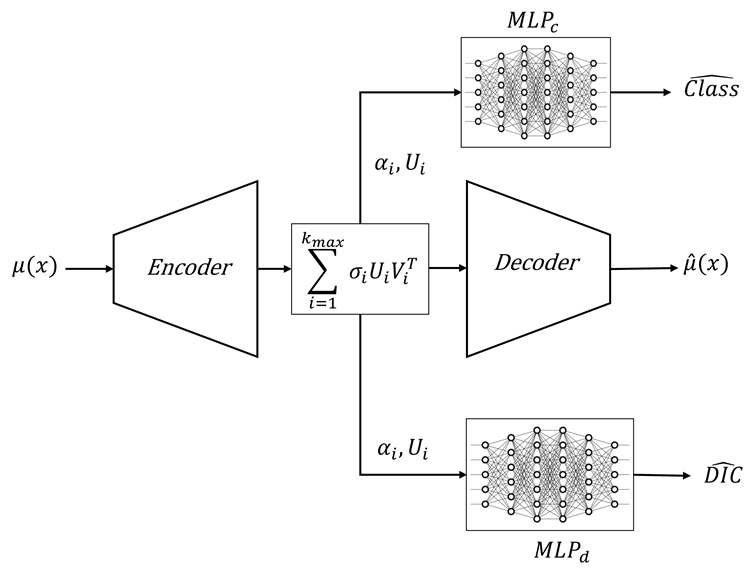
For providing a valuable response we propose a novel procedure based on the use of a powerful autoencoder with a linear vector latent space, enforced by applying a PCA at the latent space level during the encoder-decoder training. The resulting PCA modes are enforced to represent any existing “a priori” knowledge, for instance valuable statistical descriptors, complemented with the ones needed for inference purposes (classification or modelling), and finally for those needed to ensure the profiles representation after decoding.
To prove the potential of the proposed technology, hundreds of roughness profiles were measured from 12 composites tapes from different providers. The use of usual statistical descriptors was unable to classify or to predict the degree of intimate contact time evolution during the consolidation. Topological data analysis (TDA) was able to classify; however, the success of that technology was a consequence of the large differences on the macro-roughness (that corresponds to the persistent topology), however, TDA was unable to proceed with micro-roughness.
Our proposed technology was able to proceed with a single mode when the macro-micro roughness was provided, and with three modes when only the micro-roughness was used (by removing the macro-roughness to the different measured profiles). Moreover, other than classifying the tapes from the roughness, the same rationale was applied for predicting the time evolution of the degree of intimate contact.
This technology represents an unprecedented characterization and modelling tool, of critical interest in composites forming processes:
- From the tape roughness the processability can be inferred, as well as the time evolution of the degree of intimate contact predicted
- For given performances, the optimal roughness could be inferred.