
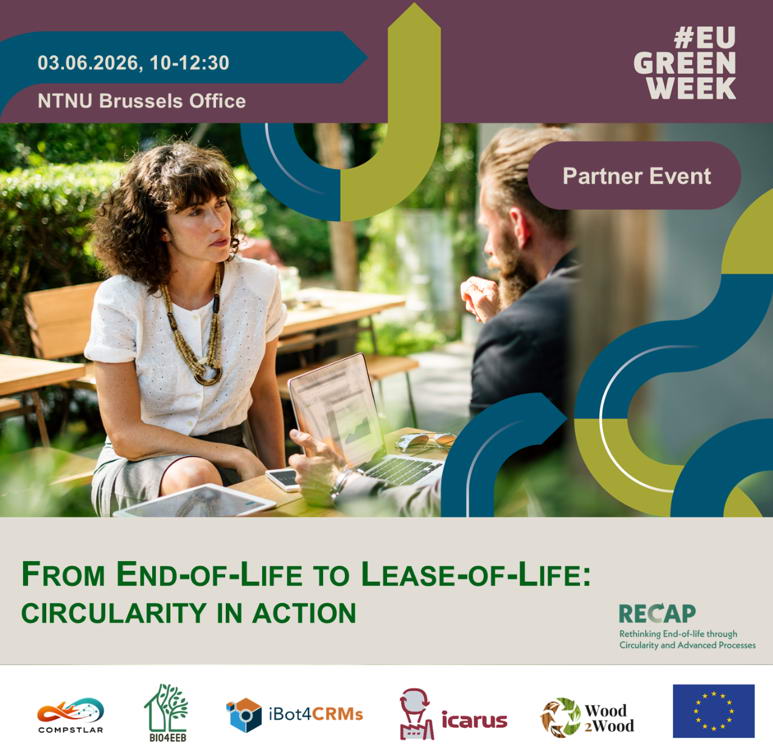
On June 3rd 2026, in Brussels, CompSTLar participated in the RECAP Cluster workshop “From End-of-Life to Lease-of-Life: Circularity in Action”, a partner event of EU Green Week. The event brought together policymakers, researchers and industry to showcase how digital technologies and circular business models can strengthen Europe’s competitiveness and resilience. Notably, the EU Green Week 2026 theme was “Investing in a Nature-Positive Economy”, highlighting the connection between sustainability and industry. This workshop was the culmination of months of preparation (since February) by the RECAP cluster partners, and it drew participation from over 120 stakeholders across Europe, both physically and online, confirming strong interest in making circular manufacturing a reality.
Keynote & Policy Context
Antonio Ferrández García (DG Research & Innovation, Industry Division) kicked off the workshop with a policy keynote. He emphasized that circularity is becoming central in EU industrial policy and R&I programmes. Antonio outlined several flagship initiatives currently shaping the circular economy agenda:
- Circular Economy Act (Q4 2026) – a forthcoming EU law to establish a Single Market for secondary raw materials, boosting supply and demand for recycled inputs.
- Advanced Materials Act (Q4 2026) – another key initiative under the Competitiveness Compass to create a strategic framework for advanced materials, explicitly aiming to promote circularity and reduce dependence on critical raw materials.
- Critical Raw Materials Act – (recently adopted) to secure EU supply chains for essential materials.
- Ecodesign Regulation (ESPR, 2024) – requiring products to be more sustainable and easier to repair.
- Clean Industrial Deal – targeting a doubling of EU’s circularity rate by 2030, as part of broader climate and industry strategy.
Within this context, Antonio stressed the importance of Horizon Europe projects for generating evidence and piloting solutions. As he put it, “We need more forward-looking Horizon Europe projects that will provide concrete evidence for EU legislations.” The keynote reinforced that EU funding and regulation must go hand-in-hand: technologies are emerging, but markets and standards must evolve too.
Project Demonstrations
The main session featured five RECAP Cluster projects presenting practical circular solutions in different industries. Each project is funded by Horizon Europe and showcases innovation at pilot or demo scale:
- CompSTLar (digital twins and advanced recycling for aerospace composites)
- BIO4EEB (bio-based materials for energy-efficient building renovation)
- iBot4CRMs (AI and robotics to recover critical raw materials from waste)
- ICARUS (digital tools to convert industrial residues into construction materials)
- Wood2Wood (advanced sorting and robotics to recycle construction and furniture wood)
Each project demo illustrated how cutting-edge technologies – from AI and robotics to digital twins – are being applied to close material loops. In CompSTLar’s case, Marc Wilms presented “Digital Twins & Circular Manufacturing: The New Standard for Aerospace”, showing how we preserve composite material quality and traceability through multiple life cycles. Anna Brékine moderated the session, facilitating lively discussions on industrial adoption.
Key Takeaways
A strong, recurring message was that the technology is ready, but scaling it remains the hurdle. As one speaker summarized: “Europe already possesses many of the technologies needed for a circular economy. The real challenge now lies in scaling these solutions and creating the regulatory and market conditions that allow them to become mainstream”. Specific insights from the event include:
- Scaling bottleneck – Numerous pilots work technically, but moving them to industrial scale requires market pull and investment. Innovation is proven; market adoption is the gap.
- Trust & Traceability – Industry needs verified quality of recycled inputs. Robust certification, quality standards and digital traceability (e.g. material passports) are critical to build confidence in secondary materials.
- Harmonized Single Market – Today’s fragmented regulations and standards across EU countries hinder circular products crossing borders. A true Single Market for secondary materials (as envisaged in the Circular Economy Act) would encourage uptake of recycled inputs across sectors.
- Systemic barriers – Existing design norms, procurement rules and incentives are built for linear production. Circular solutions often face “an uphill battle” against established business models, as current rules favor new materials.
- Policy as enabler – The EU Green Deal and related legislation (Ecodesign, Critical Raw Materials Act, upcoming CEA, etc.) can accelerate or stall circular innovation. Clear, consistent regulation is needed to turn pilots into market success.
- Circularity = Competitiveness – Every project emphasized that sustainability is not a cost but a strategic asset. Circular processes were framed as drivers of resilience, autonomy and new business opportunities, aligning with the EU’s goal to be a world leader in the circular economy.
- Skills & workforce – Deploying AI, robotics and digital twins at scale requires a new set of industry skills. Upskilling and training the workforce for a digital circular economy was highlighted as an essential but under-addressed need.
Overall, the discussion made it clear that technology alone will not achieve circularity. Instead, Europe must align policies, markets and standards to create viable business cases for recycled and upcycled products. This requires both innovation in R&D and innovation in governance and markets. The upcoming Circular Economy Act, in particular, was noted as a timely opportunity to “fix” the system by establishing the needed Single Market and incentives.
CompSTLar Contributions and Next Steps
CompSTLar was proud to be part of this exchange. We’re grateful for the insights shared by all speakers (including Fotios Konstantinidis, Irene García Martínez, Marc Wilms, Maria Alejandra Moreno Beguerisse) and facilitators (Anna Brékine, Abhimanyu Chakravorty). The high-quality contributions from every partner helped fuel a constructive debate.
Looking ahead, the RECAP Cluster will continue testing its pilot cases and sharing lessons learned. The momentum from EU Green Week 2026 – and the policy momentum behind the Circular Economy and Advanced Materials Acts – gives us confidence that circular manufacturing can move from niche to norm. CompSTLar and our fellow projects remain committed to building the evidence base and solutions needed to make circularity practical and competitive across Europe.
Thank you to the RECAP Cluster partners, our European Commission colleagues, and all 120+ participants for an engaging and inspiring event! Together, we’re turning circular innovation into industrial reality.