
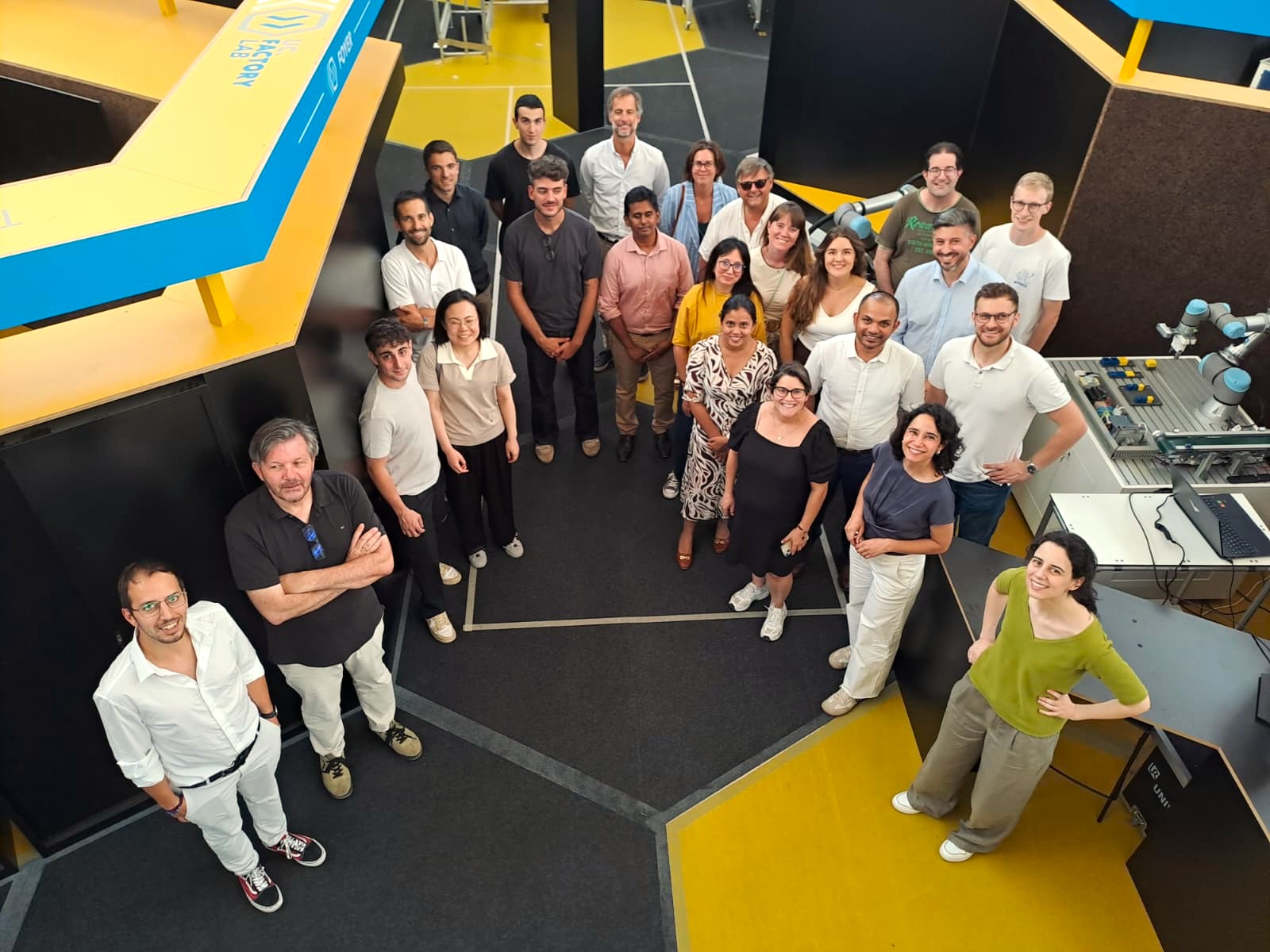
After 18 months of collaborative research and innovation, CompSTLar has reached an important milestone. As the project enters its second half, the consortium has made significant progress across its key technological pillars, laying the foundations for the next stages of development and validation.
To mark this mid-term point, we spoke with Pablo Romero Rodríguez, Project Coordinator at AIMEN, about the project’s main achievements so far, the challenges overcome, the current state of development, and what comes next.
What are the main achievements of the project during this first period?
The first half of the project has focused on building the technological foundations that will enable the different CompSTLar solutions to work together.
Across the manufacturing activities, the consortium has successfully produced and tested advanced composite structures, developed their digital twins and demonstrated the integration of fibre optic sensors for Structural Health Monitoring (SHM). Important advances have also been made in process optimisation and material characterisation, creating the knowledge needed to manufacture higher-quality composite components.
Significant progress has also been achieved in zero-defect manufacturing through the development of ultrasonic inspection methods and an innovative laser processing system with closed-loop thermal control. At the same time, Artificial Intelligence models have been developed to accurately detect and locate damage in composite structures.
Another important milestone has been the launch of digitally assisted repair technologies, combining induction-assisted welding, innovative sensing concepts and laser-induced graphene (LIG) sensors. This also applies to the recycling task, where the retrofitting of an AFP machine has been implemented successfully. In parallel, the consortium has designed the digital architecture that will connect all these technologies through the CompSTLar Digital Thread.
What have been the main challenges during this first phase?
As with any ambitious research project, many of the challenges have come from integrating multiple advanced technologies into a single digital ecosystem.
The consortium has worked to better understand complex manufacturing phenomena, improve inspection techniques capable of distinguishing real defects from manufacturing variations, and develop new laser equipment specifically designed for the project’s needs.
Developing reliable Artificial Intelligence models also required testing different machine learning approaches before identifying the most effective solution. At the same time, integrating sensing technologies, manufacturing processes and digital tools demanded close collaboration across all partners to ensure that the different technologies evolve together.
What is the current progress towards developing and implementing the project solutions?
The project is now moving from research and concept development towards validation.
Most of the core technologies have already demonstrated promising results in laboratory conditions. Numerical models, AI algorithms, ultrasonic inspection techniques, recycling, repair technologies and sensing systems are now being refined and prepared for testing in increasingly representative scenarios.
In parallel, the CompSTLar Digital Thread is taking shape. Its first functionalities have already been implemented, providing the basis for connecting data generated throughout the entire lifecycle of composite aerostructures: from design and manufacturing to inspection, repair and finally recycling at the end of life.
What lies ahead for the project in the second period?
The next phase will focus on demonstrating that these technologies perform effectively in realistic industrial conditions.
Research activities will continue to optimise manufacturing processes, validate inspection and repair technologies, and integrate Artificial Intelligence and sensing solutions into more complex composite structures. At the same time, the consortium will further develop the Digital Thread platform by connecting IIoT devices, strengthening interoperability and validating the complete digital workflow across the project’s use cases.
By the end of the project, these developments will contribute to a more digital, efficient and sustainable approach to the manufacturing, monitoring and maintenance of next-generation composite aerostructures.