
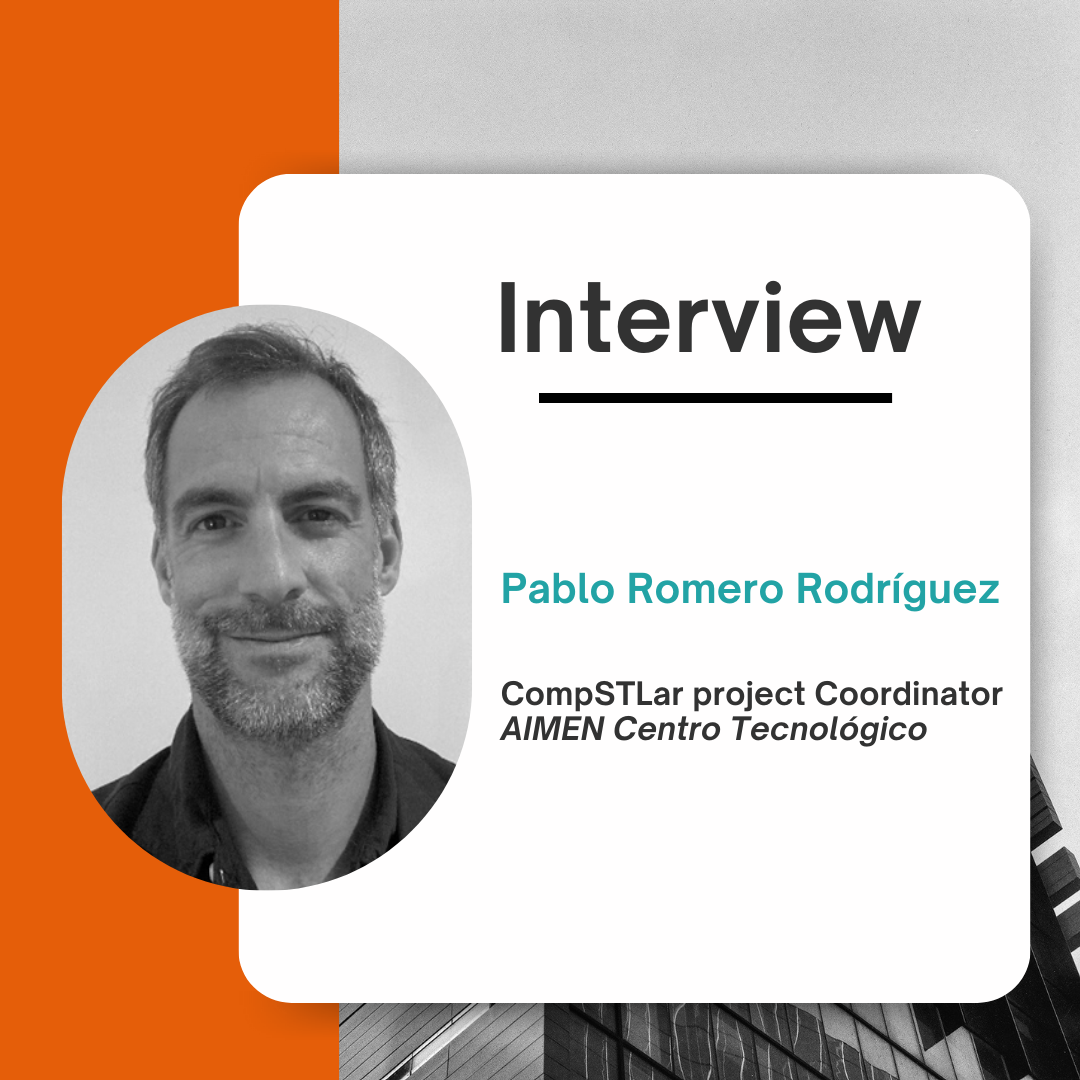
Today we are delighted to sit down with Pablo Romero Rodríguez, Coordinator of the CompSTLar project at AIMEN Technology Centre. As the organisation leading this ambitious European initiative, AIMEN is at the forefront of advancing next-generation composite structures and manufacturing technologies for the aerospace sector. In this interview, Pablo shares his insight into the vision behind CompSTLar, why it comes at a crucial time for the aviation industry, and how the project is helping shape a more sustainable, efficient, and innovation-driven future for aircraft manufacturing.
- In your own words, what is CompSTLar about?
CompSTLar is about developing next-generation composite structures with enhanced multifunctional properties in a faster manner, answering the current needs of the aircraft industry to become more sustainable, efficient and net-zero. Since the next-generation composites will be designed using new tools with better predictive capabilities, produced with new sustainable high-performance materials, and supported by smarter manufacturing and repair processes, all developments must be integrated and share knowledge to pursue the common objective. Thus, CompSTLar aims at integrating the whole aircraft value chain within a unique digital environment to exchange knowledge and accelerate innovation workflows.
- What makes CompSTLar important in current times?
Europe is leading the transition towards a net-zero aircraft industry by 2050, which represents a major challenge because it requires a holistic adaptation of each step in the value chain: materials producers, design software tools, manufacturing technologies, digitalization, MROs, and end-of-life entities.
The scale of the challenge (in terms of dimensions, stakeholders involved, and the reduced timeframes) creates a shared sense of urgency that can only be efficiently addressed if stakeholders are truly connected.
In this way, new thermoplastic materials with an improved sustainability footprint, new laser-assisted technologies for tape laying, or new sensors for Structural Health Monitoring will be developed faster. This will enable reduced structural footprint, more efficient MRO practices, next-generation sustainable propulsion systems, and certified material recycling and reuse for an overall reduced carbon footprint.
- In simple terms, what problems is CompSTLar trying to solve?
Fundamentally, CompSTLar tries to solve the very long time it takes to integrate innovations in the aircraft industry, particularly those that are safety-related and must go through a costly certification roadmap—such as integrating new materials, new aircraft systems design, or innovative and efficient maintenance schemes.
In this regard, CompSTLar focuses on manufacturing composites in a more knowledgeable way, capturing data during manufacturing to understand the degree of quality and the distribution of potential deviations, so that mitigation measures can take place as soon as possible to achieve final high-quality products. This same approach applies to thermoplastic composite repair, since CompSTLar will also focus on monitoring repair processes to guarantee that the final repaired part achieves the required performance.
- What is the unique value proposition of the project?
The unique value proposition of this project is the connection of all value chain steps through data, improving knowledge of the complete sequence in next-generation composite manufacturing. Advanced materials used during the project will combine multiple functions, such as strength, sensing, and repairability, into a single composite system.
Using robotic manufacturing, fibres are placed in customized directions to optimize performance, while embedded sensors and Internet of Things technologies enable real-time structural health monitoring. Data from these sensors feed AI and machine learning models to predict and prevent defects. If damage occurs, it can be repaired using a smart welding process, and at the end of the component’s life, a novel recycling method allows full recovery and reuse of materials. All these innovations are integrated into a digital ecosystem that supports faster, smarter, and more sustainable decision-making across the aerospace supply chain.
- What are the main challenges and opportunities that you envision for the project?
From a technical perspective, the main challenges lie in generating integrated experimental evidence about the cause–effect relationships in design–manufacturing/repair–performance of composite structures with new materials and new manufacturing processes. For example, understanding the role of graphene in lightning strike protection under relevant conditions, or enabling automated tape laying processes to predict quality levels based on thermal data.
From a coordination perspective, since CompSTLar involves 15 partners, a major challenge is aligning timelines and technical developments to successfully deliver the four demonstrators envisioned in the project: a structural demonstrator, a Structural Health Monitoring demonstrator, a repair demonstrator, and a recycling demonstrator.
The main opportunities lie in developing materials and manufacturing solutions that are truly aligned with the interests and responsibilities of the whole value chain, as well as certification requirements. Since CompSTLar integrates entities across the entire value chain, this represents a real opportunity to ensure that all key drivers for successful technical development are considered from the start.