
Introduction
As modern aircraft increasingly rely on advanced composite materials to reduce weight, improve fuel efficiency and lower emissions, maintenance and repair technologies must evolve alongside them. Airlines and maintenance providers are under growing pressure to minimise aircraft downtime while maintaining the highest safety standards. At the same time, the aviation industry is seeking more sustainable maintenance solutions that extend component lifetime, reduce material waste and lower operational costs.
Thermoplastic composites offer a promising opportunity to meet these demands. Unlike conventional thermoset composites, they can be reheated and welded, making it possible to repair damaged structures instead of replacing entire components. However, producing a reliable welded repair is far from straightforward. The material must be heated uniformly, undergo the correct thermal transitions and consolidate under carefully controlled conditions. Achieving this consistently requires not only advanced heating technology but also a detailed understanding of what happens inside the material throughout the welding cycle.
To address these challenges, the CompSTLar project is bringing together complementary expertise in induction heating, optical fibre sensing and digital process optimisation. The goal is to develop intelligent repair technologies that combine efficient hardware with real-time monitoring, paving the way for faster, more reliable and more sustainable composite repairs.
Mobile Induction Heating as the Basis for Smart Repair
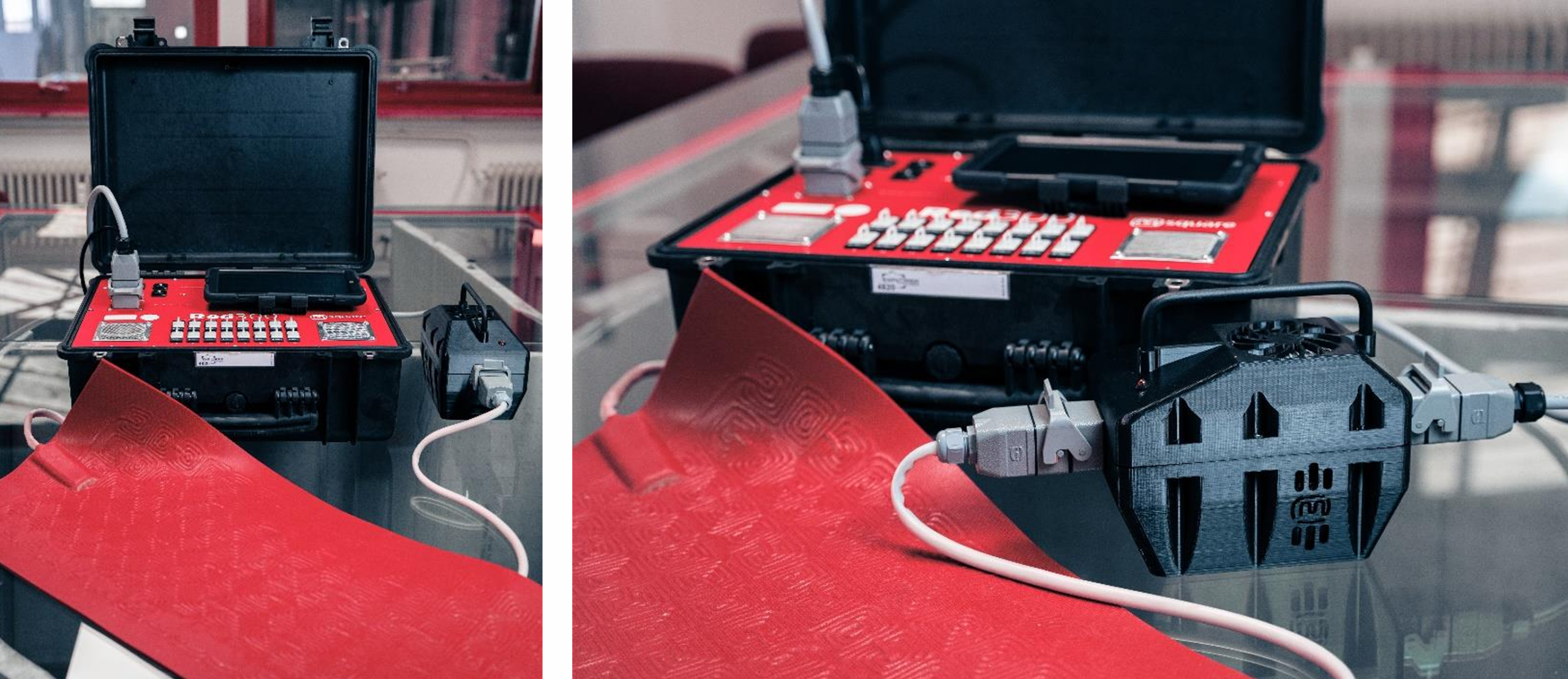
A key element of this approach is the RED300 mobile induction hot bonder, developed by MSQUARE. Unlike conventional heating methods, induction generates heat exactly where it is needed, enabling localized, contactless and highly energy-efficient heating of the repair area. This reduces unnecessary thermal exposure of the surrounding structure while allowing repairs to be carried out more quickly and with greater precision.
An important part of the ongoing development focuses on optimising the induction coils. Their geometry determines how efficiently electromagnetic energy is converted into heat and how uniformly this heat is distributed across the repair patch. A homogeneous temperature field is essential for achieving high-quality welded joints, reducing the risk of local overheating and ensuring consistent repair performance across different repair geometries.
Beyond improving the welding technology itself, these developments contribute to making induction-assisted repair more practical for industrial applications. A flexible mobile heating system with optimised coil designs can help maintenance operators perform reliable repairs more efficiently, both in the workshop and potentially in future on-site maintenance scenarios.
Monitoring What Happens Inside the Repair
Precise heating alone is not enough to guarantee a successful repair. During welding, the thermoplastic material continuously changes its physical state, and these transformations ultimately determine the quality and durability of the bonded joint. Being able to observe these changes in real time is therefore an important step towards smarter and more reliable repair technologies.
To complement the induction system, AIMEN is developing an advanced optical fibre monitoring solution. The sensing approach combines well-established Fiber Bragg Grating (FBG) sensors with a novel Fresnel optical fibre sensor, both embedded directly within the repair area.
FBG sensors provide accurate measurements of temperature and strain throughout the welding cycle, while the Fresnel sensor captures changes in the reflected optical signal as the surrounding polymer evolves during heating, consolidation and cooling. Rather than replacing conventional measurements, the two sensing technologies complement one another, providing a richer understanding of the material behaviour during welding.
This additional insight opens new possibilities for quality assurance and intelligent monitoring. By observing not only how hot the material becomes but also how it changes throughout the welding cycle, future repair systems will be able to better assess the state of the repair and support more informed decision-making.
From Experimental Research to Intelligent Process Control
Bringing together advanced induction technology and optical fibre sensing creates opportunities that extend far beyond conventional monitoring. Current experimental investigations focus on understanding the relationship between heating conditions, material behaviour and sensor response. Each experiment contributes to building a more complete picture of how thermoplastic composites behave during welding and how different heating strategies influence the final repair quality.
The knowledge gained from these investigations provides the foundation for adaptive control strategies. Instead of following fixed heating programmes, future systems could continuously evaluate sensor information and adjust the heating strategy according to the actual condition of the material. Such a closed-loop approach would allow the repair to respond to changing conditions in real time, improving consistency while reducing dependence on operator experience.
By combining experimental measurements, numerical simulations and AI-supported decision-making, the technology moves beyond simple monitoring towards intelligent optimisation. This represents an important step in the digital transformation of composite repair, where sensing and control work together to achieve reliable, repeatable and high-quality results.
Looking Ahead
Aircraft maintenance is entering an era in which repairs will become increasingly digital, connected and intelligent. Advanced manufacturing technologies, real-time sensing and data-driven decision-making are expected to play a central role in maintaining the next generation of lightweight composite aircraft.
By combining MSQUARE’s expertise in induction-assisted welding with AIMEN’s expertise in optical fibre sensing, the CompSTLar project demonstrates how these complementary technologies can work together to address some of the most important challenges in composite repair. Mobile induction heating enables efficient and flexible energy input, while embedded optical fibre sensors provide valuable insight into the evolving material state throughout the welding cycle.
As these technologies continue to mature, they have the potential to transform aircraft maintenance by improving repair quality, increasing efficiency and reducing both maintenance costs and material waste. More importantly, they illustrate how intelligent, digitally assisted repair solutions can support a more sustainable and resilient aerospace industry. Where every repair is not only faster, but also smarter.