



The Right Support Can Shape Your Future: Meet Arpana Sanker
Many of my opportunities came because someone believed in me, encouraged me to take on greater responsibility, or gave me the confidence to step beyond my comfort zone.
”
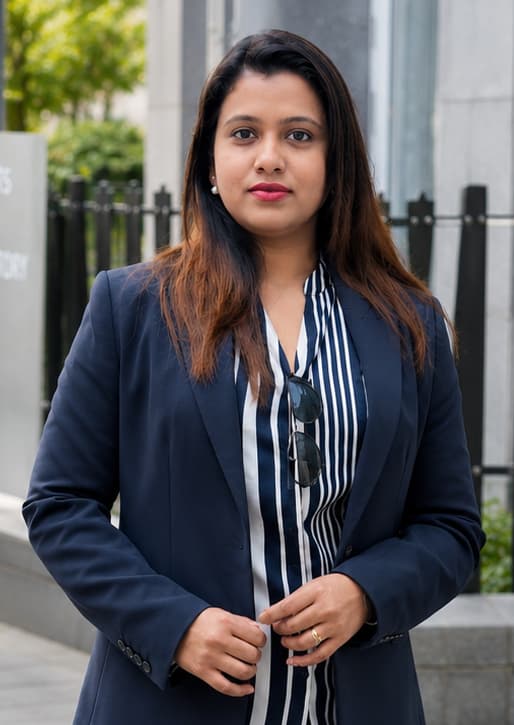
Behind every STEM career are not only skills and achievements, but also the people who encourage us to grow, challenge ourselves and embrace new opportunities.
As part of our Women in STEM campaign, we are highlighting the women contributing to CompSTLar and exploring the experiences, ideas and values that shape their approach to innovation, leadership and collaboration.
In this edition, we meet Arpana Sanker, Director at Ziegler Aerospace. An aeronautical engineer by training, she has built her career around aircraft maintenance, repair and engineering, with the ambition of contributing to a safer, smarter and more sustainable future for aviation.
Within CompSTLar, Arpana contributes to the future of aircraft maintenance and repair. She particularly values the project’s holistic approach, bringing together different stages and areas of expertise across the aircraft lifecycle.
For her, this reflects a broader principle: meaningful innovation happens when different perspectives come together around a shared challenge.
“I believe this integrated approach will make aircraft structures safer, more sustainable, and more cost-effective, setting a new industry standard.”
A career that started with a choice
Arpana’s journey into engineering did not begin with a lifelong ambition to work in aerospace. At junior college, she excelled in mathematics and science, while her family encouraged her to consider engineering as a field offering opportunities and a meaningful career.
“At that stage, it was less a lifelong dream than a deliberate choice to pursue a discipline that matched my strengths.”
As she progressed through her studies and entered the aerospace industry, however, that decision gradually became something more. Working on challenges connected to aircraft safety, reliability and performance allowed her to see how engineering knowledge could have a direct impact on the real world.
“As I progressed through my studies and into the aerospace industry, that early decision grew into a lasting passion.”
Today, that sense of purpose continues to shape her work.
“I found real purpose in tackling challenges whose solutions directly shape aircraft safety, reliability, and performance.”
When different ideas come together
For Arpana, one of the most exciting aspects of today’s STEM landscape is the convergence of different technologies.
AI, digital technologies and sustainability are transforming aerospace in different ways, but she believes their greatest potential lies in bringing them together.
“The greatest breakthroughs will come not from any single technology, but from combining them.”
For her, however, innovation is not simply about adopting new tools. It is about understanding how they can complement existing knowledge and support better decisions.
“The engineers who truly excel will fuse digital fluency with practical expertise.”
This balance between new possibilities and established expertise is central to her view of innovation. Technology can open new possibilities, but engineering judgement remains essential.
“AI should empower engineers, not replace them: engineering expertise and human judgement remain indispensable, especially for critical safety decisions.”
The people who help us grow
If innovation depends on bringing different expertise together, Arpana’s own career shows how important people can be in that process.
When asked about mentors, role models and supportive colleagues, her answer is immediate:
“Decisive—without question.”
She also learned some of her most valuable lessons from experienced colleagues. Not everything came from formal training; working alongside others allowed her to learn from their practical experience and develop both professionally and personally.
“Some of my most valuable lessons came not from formal training but from working alongside people who shared their practical knowledge, offered honest feedback, and showed me how to tackle real engineering challenges.”
For Arpana, this is why a strong support network matters.
“The freedom to ask questions, exchange ideas, and learn from diverse experiences builds confidence and leads to better decisions.”
Leadership is also about others
This experience has shaped the way Arpana sees the future of STEM and the skills that will be needed by the next generation.
Technical knowledge will remain essential, but she believes that professionals will increasingly need to combine it with communication, collaboration and continuous learning.
“Modern projects bring together experts from many disciplines, so explaining complex ideas clearly, working effectively in diverse teams, and learning from others is as important as technical mastery.”
For Arpana, this ability to work with others is not separate from leadership. It is part of it.
The future of STEM will require people who can bring different forms of expertise together, communicate across disciplines and remain open to learning.
“Those who combine technical skills with teamwork and continuous learning will be best prepared to lead.”
Changing the expectations around women in STEM
Arpana’s own experience has also shaped her perspective on the assumptions that women in STEM can still encounter.
One misconception she would particularly like to challenge is the idea that women working in STEM are there primarily to improve diversity rather than because of their technical expertise.
“One misconception I would most like to challenge is the notion that women in STEM are present mainly to improve diversity rather than for their genuine technical expertise.”
She also points to the perception that some technical roles are too physically demanding for women. In her view, this overlooks the skills that engineering, repair, inspection and maintenance actually require.
“Engineering, repair, inspection, and maintenance planning depend far more on technical knowledge, precision, analytical thinking, and problem-solving than on physical strength.”
For Arpana, people should ultimately be recognised for their knowledge and contribution rather than assumptions about gender.
“Success is defined by skill, experience, and sound engineering judgement.”
This is also where diversity and innovation meet. Different experiences can bring different perspectives to the same problem, making collaboration richer and opening the way to better solutions.
“Projects like CompSTLar also prove that true innovation comes from collaboration and diverse perspectives.”
Making a difference through engineering
At the heart of Arpana’s career is a simple idea: engineering should make a difference.
In aerospace, this means not only creating new technologies and aircraft, but also finding better ways to maintain, repair and improve what already exists.
“Engineering is, at its heart, about creating solutions that make a real difference.”
This perspective is part of what makes CompSTLar meaningful to her. The project brings together research, engineering and different areas of expertise around a common ambition to support a more sustainable future for composite aerospace structures.
For Arpana, that impact goes beyond developing individual technologies.
“Projects like CompSTLar show how research, innovation, and collaboration can extend component life while reducing waste and advancing a more sustainable aviation industry.”
A message for the next generation
For those considering a career in STEM, Arpana’s advice is not to expect to have everything figured out from the beginning.
“You do not need all the answers from the outset, but what matters is the willingness to learn, work hard, and keep improving.”
It is a message that reflects her own journey. What began as a practical decision to study engineering gradually developed into a career shaped by experience, purpose and a desire to contribute to something meaningful.
And for Arpana, the possibility of making that contribution is open to anyone willing to keep learning.
“With the right support and determination, everyone can contribute to meaningful innovations that will shape the future of aviation and society.”